


How to Find Certified Grown Diamonds for Sale Online
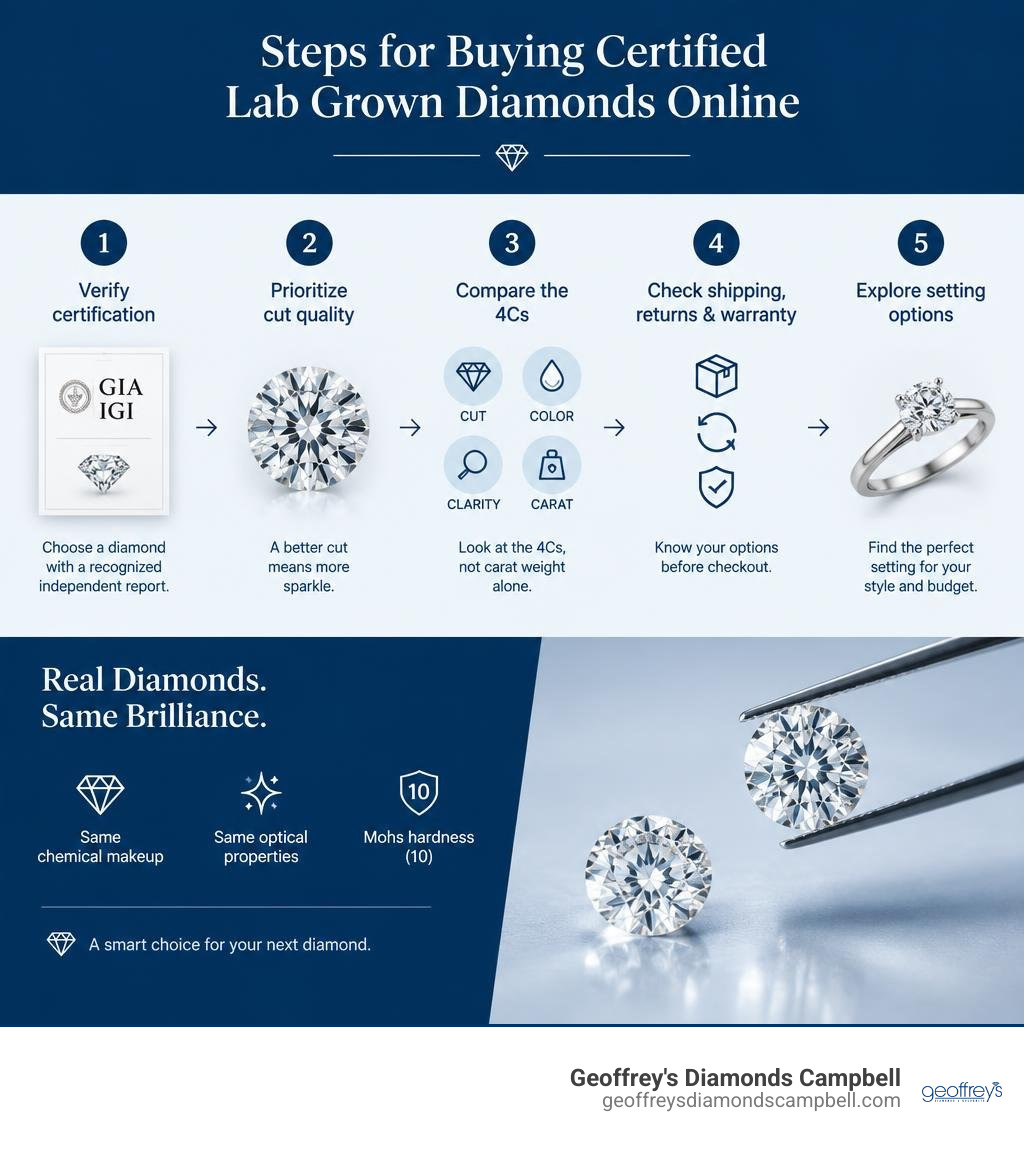
To find grown diamonds for sale online with confidence, start with the grading report, not the product photo. Choose a diamond with an independent report from IGI or GIA, confirm the report number matches the stone, then compare its cut, color, clarity, carat weight, and return policy before you buy. For broader context on how lab-created stones compare with mined diamonds, the synthetic diamond entry provides a useful technical overview.
A smart online checklist:
- Verify certification from a recognized gem lab.
- Prioritize cut quality, since it has the biggest effect on sparkle.
- Compare like-for-like diamonds by the 4Cs, not carat weight alone.
- Review shipping, returns, and warranty coverage before checkout.
- Ask about setting options if the diamond is for a custom engagement ring or fine jewelry.
Lab-grown diamonds are real diamonds with the same chemical makeup, optical properties, and 10 rating on the Mohs hardness scale as earth-mined diamonds. They are graded using the same 4Cs and can offer meaningful price savings - often about 30% to 60% less than a comparable mined diamond - though resale values can vary.
That makes them a practical option for shoppers who want a well-cut, certified diamond and room in the budget for a larger center stone, a custom setting, or both.
Understanding Creation Methods and Diamond Quality
To understand why lab-created stones deliver the exact same fire and brilliance as mined gems, it helps to look at how they are formed. Lab diamonds are not artificial imitations like cubic zirconia or moissanite; they are pure crystalline carbon. In fact, scientists have produced lab-grown diamonds since the 1950s, initially for heavy industrial cutting applications. Over decades of technological refinement, master growers perfected methods to produce gem-quality diamonds that rival the world's most pristine mined stones.
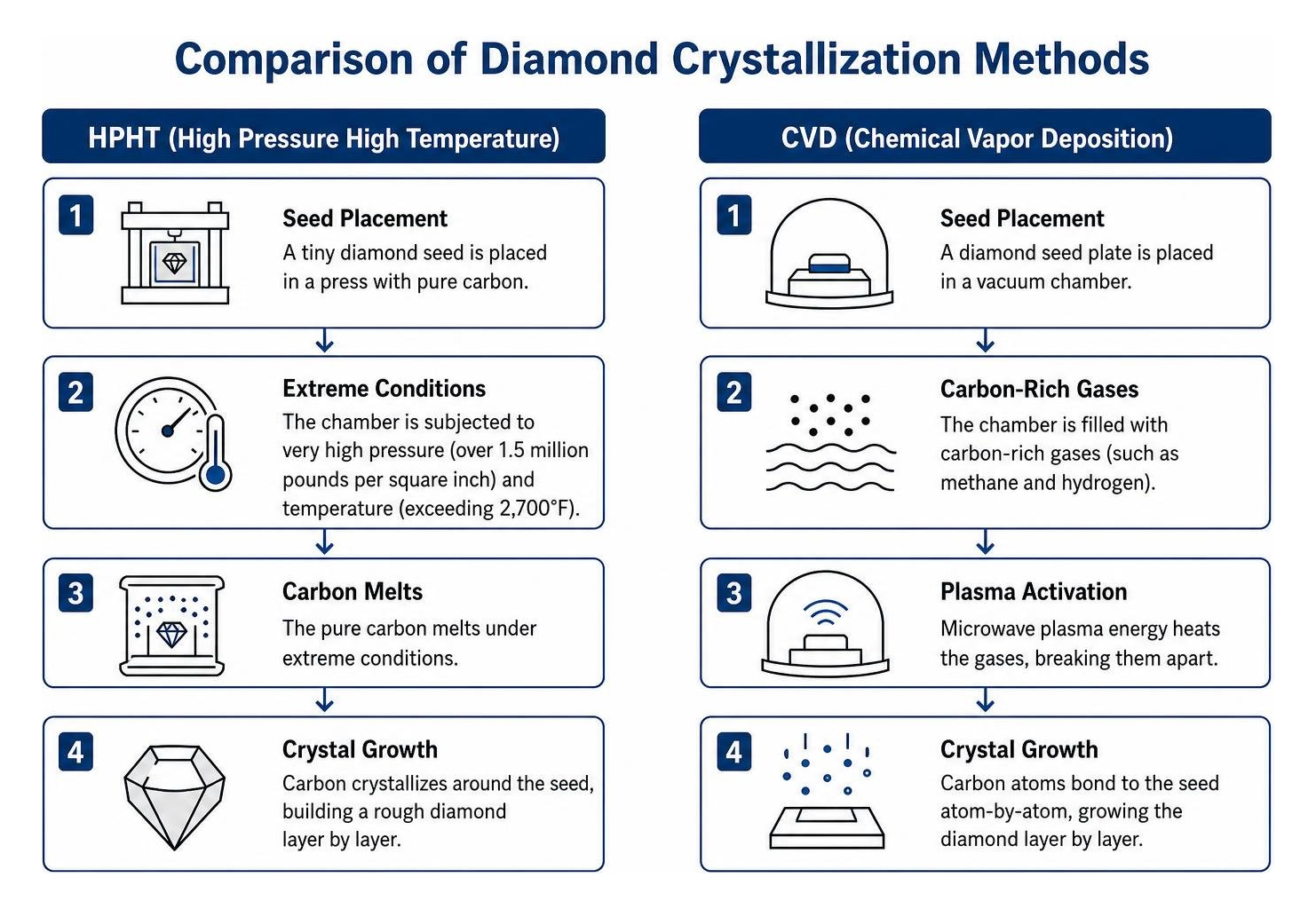
Today, two primary methods create gem-grade diamonds: High Pressure High Temperature (HPHT) and Chemical Vapor Deposition (CVD). Both replicate the intense natural environments found deep within the earth's mantle.
- High Pressure High Temperature (HPHT): This technique places a tiny diamond seed inside a mechanical press alongside pure carbon. The chamber is subjected to staggering pressures (over 1.5 million pounds per square inch) and temperatures exceeding 2,700°F. The pure carbon melts and crystallizes around the seed, building a rough diamond layer by layer.
- Chemical Vapor Deposition (CVD): In a CVD chamber, a diamond seed plate sits in a vacuum filled with carbon-rich gases (such as methane and hydrogen). When heated with microwave plasma energy, the gas molecules break apart, causing pure carbon atoms to rain down and bond atom-by-atom to the diamond seed.
Both processes produce a solid crystal structure with a hardness of 10 on the Mohs scale, meaning your stone is scratch-resistant, durable, and heirloom-quality. You can explore more technical details about these structures through our diamond education resources.
| Attribute | High Pressure High Temperature (HPHT) | Chemical Vapor Deposition (CVD) |
|---|---|---|
| Primary Mechanism | Extreme heat and physical mechanical pressure | Vacuum chamber with ionized carbon gases |
| Growth Pattern | Cuboctahedral (multi-directional growth) | Cubic (grows upward in tabular layers) |
| Typical Inclusions | Microscopic metallic flux residues | Tiny internal graphite or pinpoint clouds |
| Post-Growth Treatment | Rarely requires additional treatment | Sometimes receives HPHT treatment to enhance color |
| Physical Hardness | 10 on the Mohs scale | 10 on the Mohs scale |
Sizing and 4C Standards for Grown Diamonds for Sale
When reviewing grown diamonds for sale, you will notice they follow the exact same grading framework established by the global gemological community: Cut, Color, Clarity, and Carat Weight.
- Carat Weight: Laboratory cultivation has unlocked exceptional availability across every size. You can readily find loose stones ranging from 0.90 carats all the way past 20.00 carats.
- Color Grades: Premium selections fall primarily between D and H. D, E, and F represent completely colorless gems, while G and H provide near-colorless brilliance that appears bright white face-up in platinum or gold settings.
- Clarity Grades: Grown diamonds exhibit natural crystallization variations just like mined stones. Available clarities run the gamut from Flawless (FL) to Very Slightly Included (VS1–VS2). The sweet spot for exceptional value remains the eye-clean VS range.
- Cut Precision: Cut is the single most important factor determining sparkle. An "Ideal" or "Excellent" cut ensures light entering the stone bounces back out through the table rather than leaking out the sides or bottom.
You can use our loose lab diamond search to filter stones by their exact 4C parameters. For example, stones like this 3.05ct oval lab grown diamond demonstrate how higher carat weights, premium F color, and eye-clean VS1 clarity come together seamlessly at accessible price points.
Laboratory Certification and Value Assessment
Never purchase a loose diamond without an independent, third-party grading certificate. The International Gemological Institute (IGI) and the Gemological Institute of America (GIA) are the industry's premier authorities for authenticating lab-created stones.
A legitimate certificate provides:
- Complete optical measurements and 4C assessments.
- Confirmation of growth method (HPHT or CVD).
- A microscopic laser inscription registry number on the diamond's girdle matching the certificate.
Because lab diamonds cost between 30% and 60% less than mined diamonds with identical specifications, you capture unmatched purchasing power upfront. While mined diamonds have a longer-established secondary market for estate reselling, lab diamonds deliver maximum visual beauty and scale per dollar spent today. To safeguard your investment, we offer comprehensive jewelry appraisal services and supply official appraisal documentation so your insurer has complete records of your jewelry's verified specifications.
Key Criteria for Evaluating Grown Diamonds for Sale
Evaluating a diamond requires looking beyond the basic numbers on a grading certificate. Two diamonds with the exact same carat weight and clarity score can look remarkably different in person depending on their light performance, symmetry, and proportions.

When examining a stone:
- Examine Proportions: Pay close attention to depth percentage and table percentage. A stone cut too shallow or too deep appears dull or smaller than its actual weight.
- Check for Optical Symmetry: Look for balanced facet alignment. Excellent symmetry eliminates dark zones and gives round cuts their distinctive brilliance and fancy shapes (like ovals, pears, and radiants) even light distribution.
- Inspect Color Undertones: Low-grade CVD stones can sometimes exhibit faint brownish or grayish undertones, while rushed HPHT stones can carry a subtle bluish tint. Choosing certified D through H stones ensures a crisp, icy reflection.
Reviewing our sustainable lab diamond selection lets you compare these subtle visual nuances across a curated inventory of precision-cut stones.
Avoiding Scams When Browsing Grown Diamonds for Sale
Shopping online gives you access to a global inventory, but it also requires smart habits to protect yourself against deceptive listings:
- Watch for "Simulated" Diamonds: Some online storefronts market cubic zirconia, white sapphire, or moissanite under misleading names like "man-made diamond simulant." A genuine lab diamond must be clearly identified as 100% carbon diamond material.
- Match Inscription Numbers: Ensure the vendor allows you to independently verify the laser inscription using a jeweler's loupe or micro-camera upon receipt.
- Insist on Insured Shipping and Clear Returns: A trustworthy jeweler always ships fine jewelry via fully insured, signature-required transit and provides a transparent return policy.
To give you complete peace of mind, we established our diamond preview program alongside try before you buy options. These programs allow you to examine loose diamonds and settings in person before making your final decision.
Ethical and Environmental Benefits
Beyond design flexibility and accessible pricing, lab-grown diamonds appeal strongly to conscientious shoppers. Because they are cultivated inside modern laboratory facilities, they bypass the environmental disruption associated with traditional earth-moving extraction.
Lab-grown gems feature completely transparent chains of custody, guaranteeing a 100% conflict-free origin. When paired with modern sustainable practices—such as using carbon-neutral production partners and casting mountings from recycled precious metals—your piece represents modern luxury with a lighter footprint. Explore our eco-friendly jewelry collections to see how responsible craftsmanship translates into breathtaking fine jewelry.
Setting Your Lab Grown Diamond in Custom Fine Jewelry
A loose diamond achieves its true character when paired with a custom setting that matches your individual aesthetic. Whether you are creating a one-of-a-kind engagement ring, an anniversary pendant, or a bold right-hand ring, lab diamonds provide the financial freedom to build the exact mounting you envision.

Our master jewelers bring four decades of craftsmanship to every bespoke piece. Working with our team allows you to personalize every detail:
- Metal Choice: Select from 14k or 18k yellow gold, rose gold, white gold, or hypoallergenic platinum.
- Hidden Accents: Incorporate hidden halos, peek-a-boo accent stones, or custom filigree beneath the center basket.
- Band Profiles: Choose between delicate knife-edge shanks, classic rounded comfort fits, or intricate pavé-set bands.
You can collaborate directly with our design artisans through our custom jewelry design services, or take the first step from home and start your custom design online today.
Popular Ring Settings and Bridal Styles
Finding the perfect mounting is about balancing daily wearability with optical impact. Here are some of our most requested styles:
- Timeless Solitaires: A six-prong or four-prong solitaire lets a high-quality lab diamond take center stage without visual distraction.
- Brilliant Halos: Encircling your center stone with a halo of micro-pavé diamonds increases the perceived diameter of the ring while creating a continuous field of light.
- Three-Stone Mountings: Featuring a center stone flanked by matched side stones (such as tapered baguettes, pears, or trapezoids), this style represents a couple's past, present, and future.
To find inspiration, explore our broader engagement ring collection or read our expert advice on how to choose the perfect engagement ring. If you are looking to create a sparkling bridal stack, you can also pair your ring with stunning diamond eternity bands.
Daily Care, Cleaning, and Maintenance
Lab diamonds possess the exact same physical hardness as natural diamonds, but everyday wear inevitably exposes them to skin oils, cosmetics, hand lotions, and soaps. These residues form a thin film over the bottom facets, dampening light return and making the stone look temporarily hazy.
Follow these simple steps to keep your piece radiant:
- At-Home Cleaning: Soak your ring for 15 minutes in warm water mixed with a few drops of mild dish soap. Use an ultra-soft toothbrush to gently clean behind the setting and under the diamond's pavilion. Rinse thoroughly with clean warm water and dry with a lint-free microfiber cloth.
- Avoid Harsh Chemicals: Keep your fine jewelry away from chlorine pools, bleach, and abrasive household cleansers, which can degrade or discolor precious metal alloys over time.
- Professional Inspections: Bring your jewelry in every 6 to 12 months for a prong check and ultrasonic cleaning.
Read our complete jewelry care and cleaning guide for more pro tips, or stop by our showroom if you ever need professional jewelry repair and restorations.
Frequently Asked Questions About Lab Grown Diamonds
Do lab grown diamonds test as real diamonds?
Yes. Because lab-grown diamonds share the identical chemical makeup, refractive index (2.42), and crystal density of earth-mined diamonds, standard thermal and electrical conductivity testers will read them as genuine diamonds. Only specialized gemological equipment used by certified laboratories can identify the microscopic growth patterns that distinguish lab cultivation from deep-earth formation. When you wear lab created diamond jewelry, you are wearing a 100% real diamond.
Can lab grown diamonds become cloudy over time?
No, lab diamonds will never turn cloudy, change color, or lose their brilliance over time. Their optical structure is permanent and impervious to UV light or aging. If your lab diamond appears hazy, it is simply due to surface buildup from everyday soaps, lotions, or oils. A brief cleaning quickly restores its original showroom fire. Learn more about diamond longevity through our comprehensive diamond education guides.
How much can you save by choosing lab grown over mined diamonds?
On average, shoppers save between 30% and 60% when choosing a lab-grown diamond compared to an earth-mined stone of identical carat, color, cut, and clarity. This pricing difference lets you either maximize your diamond's size and quality within your target budget or allocate savings toward an elaborate custom mounting. Check out our fine diamond jewelry selection to compare options across different price points.
Conclusion
Finding the ideal certified lab-grown diamond comes down to transparency, verified laboratory certification, and dedicated jeweler support. By prioritizing cut quality, confirming independent grading from IGI or GIA, and working with an experienced team, you can secure an extraordinary diamond that will shine brilliantly for generations to come.
At Geoffrey's Diamonds Campbell, we combine four decades of trusted fine jewelry experience with modern custom design capabilities. Every bespoke ring and fine jewelry piece we create is backed by our comprehensive lifetime craftsmanship warranty. Ready to take the next step? Visit our Campbell, California showroom or explore certified lab grown diamonds online today to begin crafting your dream piece.