


How to Choose a 2 Carat Emerald Ring
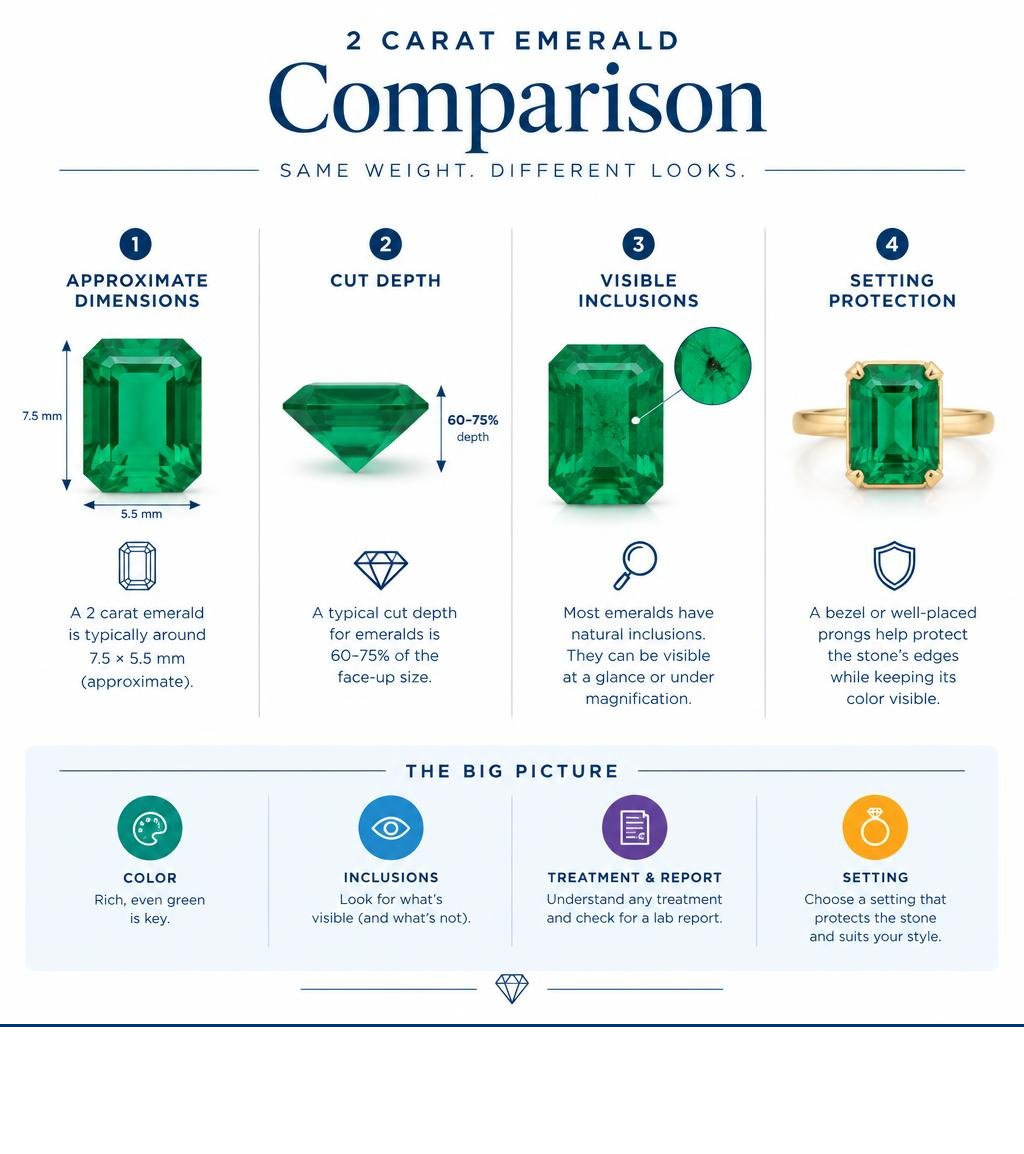
Start with color, not carat weight. When comparing 2 carat emeralds, look for a rich, even green that appeals to you. Then check whether inclusions are easy to see, how much treatment the stone has received, and whether a lab report confirms its identity and any stated origin. Compare the stones in person if you can: two emeralds of the same weight can look very different.
A 2 carat emerald weighs 0.4 grams, but its face-up size depends on its cut and depth. For a ring you'll wear often, the setting matters too. A protective bezel or well-placed prongs can help shield the stone's edges without hiding the color you chose it for. For a broader look at how emeralds compare with other gemstones, the Gemological Institute of America offers detailed guidance on emerald quality factors.
Key Factors That Determine 2 Carat Emerald Value and Quality
Evaluating a colored gemstone is fundamentally different from shopping for white diamonds. While diamonds are graded to strict mathematical formulas of light performance, emerald valuation revolves around visual poetry: richness of color, crystalline transparency, natural inclusions, origin, and the degree of enhancement.
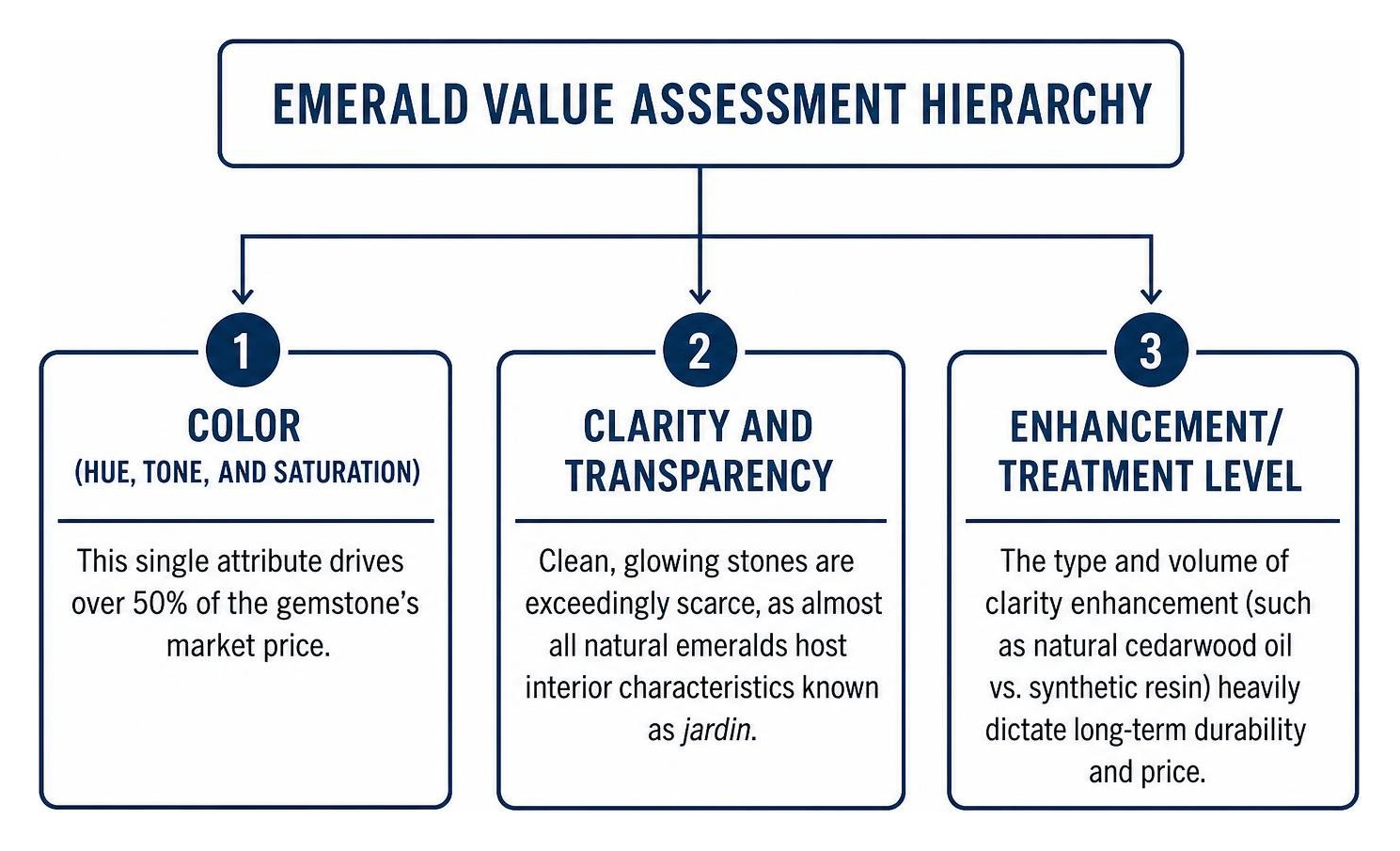
Emeralds belong to the beryl mineral family, gaining their vibrant green hues from trace elements of chromium, vanadium, and iron. When judging value, experts assess four primary pillars:
- Color (Hue, Tone, and Saturation): This single attribute drives over 50% of the gemstone's market price.
- Clarity and Transparency: Clean, glowing stones are exceedingly scarce, as almost all natural emeralds host interior internal characteristics known as jardin.
- Enhancement/Treatment Level: The type and volume of clarity enhancement (such as natural cedarwood oil vs. synthetic resin) heavily dictate long-term durability and price.
- Geographic Provenance: Historical mines that yield legendary visual traits demand significant premiums.
| Origin | Primary Trace Elements | Typical Color & Visual Profile | Inclusions & Internal Traits | Relative Market Premium |
|---|---|---|---|---|
| Colombia (Muzo, Chivor, Coscuez) | High Chromium, Low Iron | Pure, warm, glowing green with minimal secondary yellow or blue undertones | Three-phase inclusions (gas, liquid, rock salt crystal); delicate jardin | Highest |
| Zambia (Kagem) | High Vanadium, Moderate Iron | Deep, vivid bluish-green; exceptional transparency and glass-like brilliance | Two-phase inclusions; blocky crystals; generally fewer surface-reaching fissures | High to Moderate |
| Brazil (Belmont, Bahia) | Variable Chromium & Iron | Lighter yellowish-green to medium mint tones; strong crystal structure | Mica platelets, dark metallic inclusions; varied clarity levels | Moderate to Entry |
Color, Tone, and Saturation Dynamics
When you evaluate green gemstones, color breaks down into three distinct elements:
- Hue: The basic green color, along with any secondary tint (such as blue or yellow). Pure green to slightly bluish-green commands the highest admiration.
- Tone: The lightness or darkness of the stone. The sweet spot sits between medium and medium-dark (around 60% to 75% tone). Stones that are too dark appear black in dim light, while overly pale gems resemble green beryl rather than vivid emeralds.
- Saturation: The strength or intensity of the hue. High saturation yields a glowing, electric green that holds its character across all lighting conditions.
Unlike colorless natural diamonds, where the goal is an absence of body tint, an emerald's identity relies on deep, saturated pigment without becoming dull or opaque.
Understanding Inclusions, Enhancements, and Clarity Grading
Nearly every natural emerald contains internal fractures and mineral crystals. Gemologists call this garden-like network the jardin (French for "garden"). Rather than viewing inclusions solely as flaws, the jewelry industry treats them as nature's fingerprint, verifying that the gem is natural rather than synthetic.
Because emeralds form under intense tectonic pressure, surface-reaching fissures are standard. For centuries, gem cutters have treated emeralds with natural oils to fill microscopic fissures. This process matches the stone's refractive index and improves transparency.

- Minor Cedarwood Oil: Traditional, stable, fully reversible, and universally accepted by international auction houses.
- Moderate to Significant Oil: Common for commercial-grade stones; requires gentle care over time.
- Polymer Resins (e.g., Opticon, Permasafe): Hardened artificial fillers that provide structural stability but can yellow or degrade over decades.
To learn more about how clarity and grading differ across gemstone families, our guide to diamond education highlights the essential differences between colored gemstones and diamond grading scales.
Physical Dimensions, Carat Weight, and Visual Impact
A common misconception among modern buyers is assuming that all 2-carat gems share the same visual footprint. Carat is strictly a measure of weight (1 carat = 0.20 grams), not visual surface area.

Visual Spread: Comparing a 2 Carat Emerald to a Diamond
Emerald has a specific gravity (density) of roughly 2.70 to 2.78, whereas diamond has a specific gravity of 3.52. Because emeralds are significantly less dense, a 2 carat emerald yields roughly 20% to 30% more face-up surface area than a 2-carat diamond of the same cut.
A standard 2-carat emerald cut diamond measures roughly 8.5 x 6.0 mm, while a well-proportioned 2-carat step-cut emerald often measures around 9.0 x 7.0 mm. For an even more substantial visual impression, buyers seeking maximum finger coverage frequently compare this look against a 3 carat emerald cut diamond.
Recommended Cuts for a 2 Carat Emerald
Cutting an emerald requires immense skill. The lapidary must minimize stress on natural fractures while maximizing rich color saturation:
- Classic Emerald Cut (Step Cut): The undisputed favorite. Rectangular step facets with truncated, beveled corners reduce internal strain, safeguard weak corners, and create deep, crystalline reflections.
- Cushion Cut: Soft, rounded corners and brilliant-style pavilion facets bring extra fire and brilliance to deeper-toned stones.
- Oval Shape: Provides expansive face-up surface area and softens elongated finger silhouettes.
- Cabochon: A smooth, domed polish without facets, ideal for highly included, richly colored emeralds with romantic vintage appeal.
Setting Styles, Protection, and Ring Designs
Emeralds sit at 7.5 to 8.0 on the Mohs hardness scale. While resistant to surface scratching, internal fissures make them more brittle than sapphires or diamonds. Choosing the right mounting is essential for daily enjoyment.
Best Ring Mounts to Safeguard Fragile Gemstones
- Bezel and Semi-Bezel Mountings: A custom-shaped metal collar wraps around the emerald's perimeter, protecting the fragile girdle from accidental knocks against hard surfaces.
- V-Prong and Corner-Cap Settings: Heavy, tailored prongs cradle the gem's delicate corners, preventing impact fractures while allowing light to enter from the sides.
- Protective Halo Surrounds: Enclosing the emerald within a frame of smaller diamonds acts as a physical bumper while creating a striking color contrast. Explore our curated selection of emerald cut engagement rings to see how protective settings combine daily wearability with refined design.
Complementing Your Emerald with Wedding Bands
Pairing an emerald centerpiece with a wedding band requires thoughtful balance:
- Eternity Bands: Clean step-cut diamond bands offer geometric harmony beside a centerpiece. Pair your ring with emerald cut diamond bands for a cohesive aesthetic.
- Curved and Open Bands: If your center setting sits low against the finger, custom-contoured or chevron bands allow flush stacking without rubbing against the emerald's mounting. Discover style pairings across our gallery of emerald cut wedding bands.
Pricing Benchmarks, Certification, and Care
Fine emerald pricing operates on an exponential curve. Because clean, unenhanced 2-carat specimens are exceptionally rare, slight variations in color and clarity can dramatically alter market value.
| Quality Tier | Color & Clarity Grade | Typical Enhancement Level | Estimated Price Range (USD) |
|---|---|---|---|
| Commercial Grade | Light/opaque green; heavy surface fissures | Moderate to Significant Resin/Oil | $1,500 – $4,500 |
| Fine Quality | Medium vivid green; moderate natural jardin | Minor to Moderate Traditional Oil | $5,000 – $14,000 |
| Extra Fine / Investment | Rich, glowing green; high transparency; Colombian/Zambian | Minor Traditional Oil | $15,000 – $35,000+ |
| Museum / Unenhanced | Pure vivid green; exceptional crystal; historic mine | None (No Clarity Enhancement) | $40,000 – $80,000+ |
When making your purchase, always insist on an independent laboratory report from recognized authorities like GIA, GRS, or Gübelin. These certificates verify natural origin and measure clarity enhancement levels. For buyers considering classic diamond alternatives, explore our guide to choosing a 2 carat wedding ring to contrast pricing dynamics.
Essential Care Guidelines
To keep your gemstone glowing for generations:
- Never use ultrasonic or steam cleaners: High-frequency vibrations and heat can strip natural oils from internal fissures or expand existing inclusions.
- Clean with warm, soapy water: Use a soft-bristle toothbrush, mild dish soap, and lukewarm water. Dry thoroughly with a microfiber cloth.
- Store separately: Keep emeralds in dedicated fabric pouches away from harder gems like diamonds and rubies.
Frequently Asked Questions About 2 Carat Emerald Rings
How much does a high-quality 2 carat emerald cost?
A high-quality 2 carat emerald featuring vivid green saturation, good transparency, and minor traditional oil treatment typically ranges from $8,000 to $25,000. Top-tier Colombian specimens with negligible clarity enhancement can command $35,000 or more.
Is a 2 carat emerald durable enough for everyday wear?
Yes, provided it is mounted in a protective setting (such as a bezel, halo, or corner V-prongs) and treated with mindful care. Remove your ring before rigorous activities, heavy lifting, or exposure to harsh household chemicals.
How do I verify if a 2 carat emerald is natural and ethically sourced?
Require a recognized third-party gemological report (such as GIA or GRS) confirming the stone's natural beryl composition, geographic origin, and treatment level. Reputable jewelers maintain transparent supply chains and work directly with certified cutting houses.
Conclusion
Choosing a 2 carat emerald means embracing an ancient legacy of color, character, and distinctive elegance. By balancing rich saturation, mindful clarity expectations, and protective craftsmanship, you secure a piece that remains vibrant for decades to come.
At Geoffrey’s Diamonds Campbell, our team brings four decades of gemological expertise to help you select, evaluate, and custom-set exceptional gemstones. Explore our complete collection of handcrafted engagement rings or visit our Campbell, California showroom to begin your bespoke design journey today.